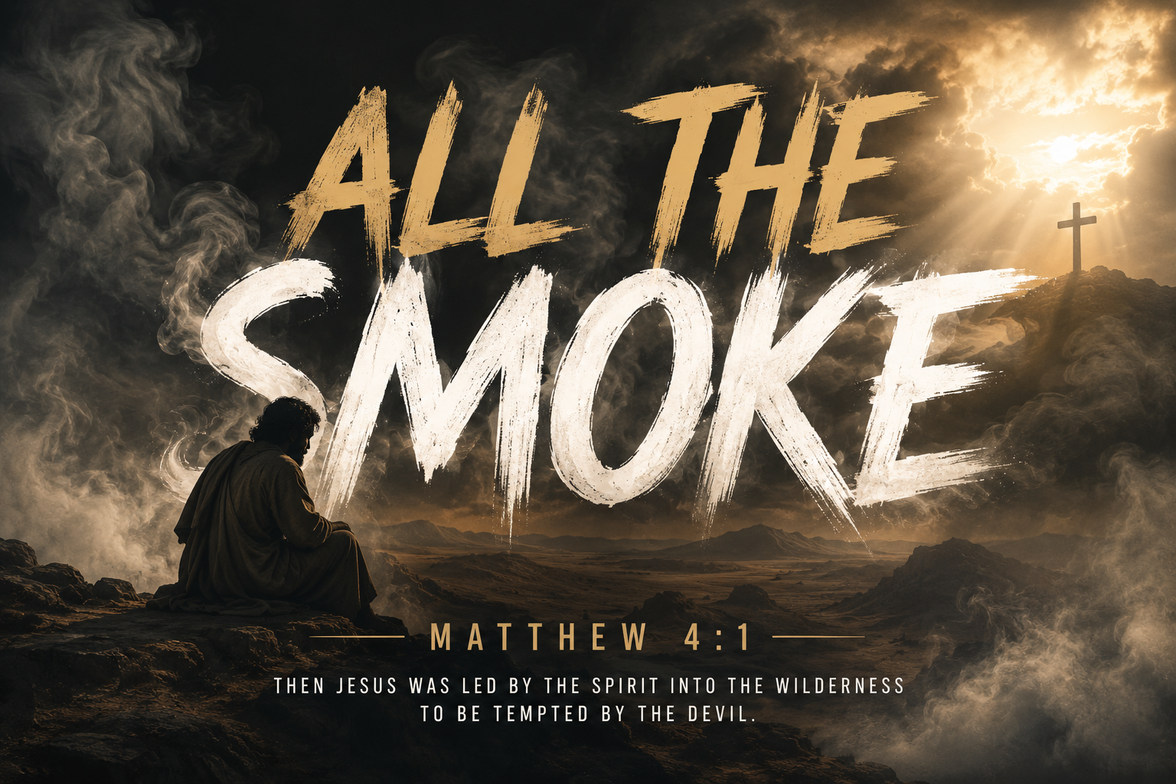
Many people believe that following God should lead only to comfortable, peaceful, and predictable places.
We assume that obedience should protect us from hardship.
We believe that if we pray, serve, worship, give, and remain faithful, we should be able to avoid wilderness seasons.
But Matthew 4:1 presents a different picture:
“Then Jesus was led by the Spirit into the wilderness to be tempted by the devil.”
Jesus did not enter the wilderness because He had disobeyed God.
He was led there by the Holy Spirit.
This means every difficult season is not proof that you missed God. Sometimes the wilderness is part of God’s process for strengthening, developing, and confirming what He has placed inside you.
The enemy may want to use the wilderness to destroy you, but God can use the same wilderness to reveal who you are.
Jesus Was Loved Before He Performed
To understand Matthew 4, we must first look at what happened in Matthew 3.
Jesus was baptized by John. As He came out of the water, the Spirit of God descended upon Him, and the Father declared:
“This is My beloved Son, in whom I am well pleased.”
At this point, Jesus had not performed any recorded public miracles.
He had not turned water into wine.
He had not raised Lazarus from the dead.
He had not opened blind eyes.
He had not healed the sick.
He had not preached to large crowds.
Yet the Father declared His love and pleasure before Jesus performed anything publicly.
That truth matters because many of us try to earn what God has already offered.
We attempt to perform our way into His love.
We serve so He will notice us.
We work so He will approve of us.
We compare ourselves with others to determine whether we are worthy.
We believe we must clean ourselves up before we can approach Him.
But the gospel declares that God’s love is not a prize we earn through flawless performance.
We obey because we are loved—not so that we can become loved.
We serve because we belong to Him—not so that we can earn a place in His family.
Your identity must be established before the battle begins.
Before Jesus entered the wilderness, He knew:
“I am the Father’s beloved Son.”
The Father’s Word Can Carry You
Throughout His earthly ministry, Jesus prayed to the Father many times. Yet Scripture records relatively few occasions when the Father spoke audibly in response.
Before the wilderness, the Father gave Jesus a clear word:
“You are My Son.”
“I love You.”
“I am pleased with You.”
That word carried Jesus through the wilderness.
It carried Him through rejection.
It carried Him through betrayal.
It carried Him through Gethsemane.
It carried Him to the cross.
It carried Him through the grave and into resurrection.
Sometimes we continue asking God for a new word while neglecting what He has already spoken.
We ask:
“God, where are You?”
“Do You still love me?”
“Have You forgotten me?”
“Am I still Yours?”
But God may be reminding us:
“I already told you that you belong to Me.”
“I already told you that nothing can separate you from My love.”
“I already promised never to leave you nor forsake you.”
When life becomes difficult, return to what God has already said.
Your circumstances may change, but His Word remains.
The Wilderness Does Not Mean God Left You
After Jesus was baptized and affirmed by the Father, the Holy Spirit led Him into the wilderness.
That can be difficult to understand.
Why would God lead Jesus into a place associated with barrenness, isolation, hunger, and testing?
Why would God lead any of us into a season that feels empty?
There are times when following God will lead us through uncomfortable places.
Following God may lead us through uncertainty.
It may lead us through grief.
It may lead us through a difficult transition.
It may lead us to confront unhealthy patterns.
It may lead us into counseling.
It may require us to face something we have avoided for years.
It may lead us away from what is familiar before we can see what is next.
The wilderness does not necessarily mean God is punishing you.
It may be a place where He intends to meet you.
Moses encountered God in the wilderness.
Elijah encountered God in the wilderness.
The Israelites learned dependence upon God in the wilderness.
Jesus was tested in the wilderness.
A wilderness season can become a place of encounter, preparation, and revelation.
The Enemy Wants to Distort God’s Purpose
The Holy Spirit led Jesus into the wilderness, but the devil came there to tempt Him.
God and the enemy may have different intentions concerning the same season.
God may intend to strengthen your faith.
The enemy may try to use the season to produce doubt.
God may intend to heal your identity.
The enemy may use the season to question your worth.
God may intend to draw you closer.
The enemy may attempt to convince you that God has abandoned you.
God may intend to prepare you for your assignment.
The enemy may try to distract you from it.
The place where God wants to shape you may also become the place where the enemy attempts to discourage you.
This is why spiritual discernment matters.
Do not allow the enemy’s activity to make you misinterpret God’s presence.
The battle does not mean God is absent.
The confrontation may actually reveal that something important is happening in your life.
Temptation Is Not the Same as Sin
Many believers experience shame simply because they were tempted.
They think:
“If I were truly saved, I would never feel this temptation.”
“If I were spiritually mature, this desire would never appear.”
“If I loved God enough, I would never struggle.”
But Jesus was tempted.
Hebrews teaches that He was tempted in every way, yet He remained without sin.
Temptation itself is not the sin.
The issue is how we respond when temptation appears.
You may be tempted to return to an unhealthy relationship.
You may be tempted to use a substance to escape your emotions.
You may be tempted to respond in anger.
You may be tempted to compromise your integrity.
You may be tempted to give up.
The appearance of temptation does not automatically mean you have failed.
It means you have reached a moment when you must decide where you will place your dependence.
Willpower Is Not Enough
One of the greatest mistakes we make is believing we can defeat temptation through confidence and willpower alone.
We say:
“I can handle it.”
“I know where the line is.”
“I will only stay for a little while.”
“I will not go as far as I did last time.”
“I am strong enough now.”
But placing yourself repeatedly near the same temptation while depending only upon your own strength is dangerous.
Jesus did not enter the wilderness alone.
He was filled with and led by the Holy Spirit.
The same Holy Spirit who led Him was present with Him during the confrontation.
Victory over temptation requires more than determination.
We need the power of the Holy Spirit.
We need prayer.
We need wisdom.
We need accountability.
We need boundaries.
We need the Word of God.
We need the humility to admit that our strength is insufficient.
The moment you say, “I do not need help,” you become especially vulnerable.
Jesus Responded With the Word
Each time the enemy tempted Jesus, Jesus answered with Scripture.
He did not respond with personal opinion.
He did not debate endlessly.
He did not attempt to impress the devil with His intelligence.
He declared what God had already spoken.
This reveals why knowing Scripture is essential.
The Word gives us truth when our emotions become unreliable.
The Word gives us direction when temptation creates confusion.
The Word reminds us of our identity when the enemy tries to rename us.
The Word exposes lies that sound convincing.
However, the sermon also reminds us that the enemy can misuse Scripture.
The devil quoted from Psalm 91 while tempting Jesus.
He used biblical words without honoring their meaning or context.
This is why believers need more than isolated verses taken from social media posts.
We need to study Scripture carefully.
We need to understand what the Bible actually teaches.
We need to recognize when spiritual language is being used to manipulate, deceive, or justify disobedience.
The enemy knows how to quote words.
But Jesus knew the Word.
Your Confrontation May Be Confirmation
The wilderness confrontation did not destroy Jesus’ identity.
It confirmed it.
Before the wilderness, the Father declared that Jesus was His Son.
During the temptation, the enemy repeatedly challenged that identity:
“If You are the Son of God…”
The enemy often attacks what God has already spoken.
If God says you are loved, the enemy will attempt to convince you that you are rejected.
If God says you are forgiven, the enemy will remind you of your past.
If God says you have purpose, the enemy will magnify your failures.
If God calls you forward, the enemy will attempt to make you feel disqualified.
But what you are confronting may be confirmation that God is developing something significant within you.
The battle may be confirming that your faith is growing.
The pressure may be confirming that God is deepening your dependence.
The resistance may be confirming that you are moving in the right direction.
The confrontation does not define you.
God’s Word defines you.
Some Things Must Be Confronted
Wilderness seasons often reveal issues we were able to hide during comfortable seasons.
You may be confronted with bitterness toward a parent.
You may be confronted with fear of abandonment.
You may be confronted with an unhealthy relationship pattern.
You may be confronted with poor financial habits.
You may be confronted with substance dependence.
You may be confronted with unresolved grief.
You may be confronted with anger you have continued to justify.
You may be confronted with the need to forgive.
The purpose of confrontation is not always condemnation.
Sometimes God reveals an issue because He intends to heal it.
He brings something into the light so it no longer controls you from the darkness.
The question becomes:
Will you confront it with the help of the Holy Spirit, or continue surrendering to it?
Jesus Understands Your Struggle
Jesus was not tempted from a distant or untouched position.
He had fasted for forty days and forty nights.
He was physically hungry and weak.
The enemy came during a moment of human vulnerability.
This matters because Jesus is not disconnected from our experience.
He understands temptation.
He understands rejection.
He understands loneliness.
He understands betrayal.
He understands grief.
He understands exhaustion.
He understands what it feels like to pray while facing overwhelming pressure.
When you come to Jesus and say, “Lord, I am struggling,” He does not respond without compassion.
He is the perfect High Priest who understands human weakness while remaining without sin.
You are not praying to someone who cannot relate.
You are praying to the One who entered our human experience and overcame.
Jesus Took All the Smoke
The central truth of this message is that the full weight of victory does not rest upon us.
Jesus entered the wilderness.
Jesus faced the adversary.
Jesus resisted temptation.
Jesus lived without sin.
Jesus carried the cross.
Jesus defeated death.
Jesus rose with all power.
Jesus took all the smoke.
This means we are not fighting to manufacture a victory through human effort.
We are learning to stand in the victory Christ has already secured.
That does not mean believers never resist, pray, establish boundaries, or exercise discipline.
It means those actions flow from dependence upon Jesus rather than confidence in ourselves.
We do not fight alone.
We do not overcome through our own righteousness.
We do not save ourselves.
We lean upon the One who has already overcome.
Stop Trying to Be Your Own Hero
Many of us have developed a hero complex.
We try to rescue ourselves.
We try to rescue everyone around us.
Every time someone calls, we go.
Every time someone has a problem, we attempt to solve it.
Every time we struggle, we immediately create another strategy.
We live as though everything depends upon us.
But you are not the Savior.
Jesus is.
You are not responsible for carrying every person’s burden.
You are not responsible for controlling every outcome.
You are not responsible for becoming strong enough to defeat every enemy alone.
There are battles you must surrender to God.
There are people you must place into His hands.
There are burdens you must release.
There are situations where your most faithful act may be to stop trying to control the result.
Stop trying to be Jesus in your own story.
Let Jesus be Jesus.
Do Not Make Spiritual Discipline an Idol
Prayer, fasting, Bible reading, worship, and service are essential spiritual disciplines.
But even good practices can become misplaced sources of confidence.
We may begin thinking:
“I read my Bible every day, so I can handle anything.”
“I serve in ministry, so I must be spiritually safe.”
“I preach, sing, or lead, so I do not need help.”
“My title proves that I am strong.”
Spiritual disciplines are meant to draw us closer to Jesus.
They were never meant to replace our dependence upon Jesus.
Your prayer life is not your Savior.
Your church attendance is not your Savior.
Your ministry title is not your Savior.
Your knowledge is not your Savior.
Jesus is your Savior.
Anything we trust more than Jesus can become an idol—even something that appears spiritual.
Fight From Victory
Many people are fighting for something Jesus has already given them.
They are trying to earn forgiveness.
Trying to establish their worth.
Trying to prove they belong.
Trying to defeat the enemy as though Christ never went to the cross.
But Jesus has already won.
You are not trying to convince God to love you.
You are loved.
You are not trying to purchase grace.
Grace has been given.
You are not trying to create victory.
Victory has been secured through Christ.
You fight from victory when you pray from the confidence that Jesus has already overcome.
You fight from victory when you obey even while the outcome is uncertain.
You fight from victory when you stop allowing shame to determine your identity.
You fight from victory when you refuse to face temptation alone.
You fight from victory when you depend upon the Holy Spirit instead of your flesh.
Stop Fighting the Wrong Way
There are moments when God may tell you to stop fighting through arguments, angry messages, unnecessary phone calls, manipulation, or constant defensiveness.
The weapons of our warfare are not merely human.
You may need to stop yelling and start praying.
Stop reacting and start listening.
Stop forcing and start trusting.
Stop trying to prove yourself and stand on what God has already said.
This does not mean ignoring abuse, avoiding accountability, or refusing wise action.
It means recognizing that some spiritual battles cannot be won through fleshly responses.
Fight on your knees.
Fight through obedience.
Fight through truth.
Fight through forgiveness.
Fight through boundaries.
Fight through dependence upon Jesus.
You Are Not Alone in the Wilderness
A wilderness season can feel isolating.
It can make you believe no one understands.
It can convince you that God led you somewhere only to abandon you there.
But God promises never to leave nor forsake His people.
The Holy Spirit who led Jesus into the wilderness remained present throughout the temptation.
God is still with you in your wilderness.
He is with you during the struggle.
He is with you during the temptation.
He is with you while you are trying to understand what this season means.
Do not allow confrontation to make you walk away from God.
Do not allow difficulty to erase what He has already spoken.
Do not allow the wilderness to make you question whether you still belong to Him.
You are not facing this alone.
Make This Declaration
Declare this over your life:
I am loved before I perform.
God’s approval is not based on my accomplishments.
The wilderness does not mean God has abandoned me.
Temptation does not define my identity.
The Holy Spirit is present with me.
I will answer lies with the truth of God’s Word.
My confrontation may be God’s confirmation.
I will stop trying to be my own hero.
Jesus took all the smoke.
I will fight from the victory Christ has already secured.
Closing Prayer
Father, thank You for loving us before we accomplish anything. Thank You that our identity is established through Your love and not through our performance.
When we enter wilderness seasons, help us remember that You have not abandoned us. Give us discernment to recognize the enemy’s lies and strength to respond with Your Word.
Forgive us for the times we have depended upon our own willpower, knowledge, titles, and spiritual routines more than we have depended upon Jesus.
Holy Spirit, lead us, empower us, and help us resist temptation. Bring healing to every issue the wilderness has exposed. Help us confront what must be confronted without falling into condemnation.
Teach us to stop trying to be our own heroes. Remind us that Jesus has already entered the battle, defeated the adversary, and secured our victory.
We choose to fight from victory and not merely for victory.
In Jesus’ name, amen.
Section to place above the sermon video
Watch the Full Message
Are you facing temptation, confrontation, or a wilderness season that has caused you to question whether God is still with you?
Watch guest preacher Elder David Jackson’s complete message, “All the Smoke,” and discover how to overcome temptation through the Holy Spirit, stand on God’s Word, and fight from the victory Jesus has already secured.